How to write with AI without sounding like AI

Write the opinions, stories and numbers yourself, then let AI draft around them from a brief and a voice guide built on your past posts. Edit every draft by hand and scan it for known tells: overused words, "not X but Y" contrasts, reflex lists of three, uniform sentence length, hedges and recap endings.
AI writing sounds generic because the model fills every gap you leave with the most likely phrase. This guide is part of the B2B creator-operator playbook, and it covers the tells, a fix for each one, and the workflow that keeps your voice in the draft.
Key points
Readers who use AI often are good at spotting it. In one 2025 study, five such readers voting together misclassified 1 of 300 articles.
The word list changes every year, so a banned-word filter alone will not save a draft.
Structure gives AI away as often as vocabulary does: stock contrasts, padded lists, even rhythm and summary endings.
AI drafts well from material you supply and badly from a blank page.
Stories, opinions and numbers have to come from you, because a model can only invent them.
What makes AI writing sound like AI?
Four things: a narrow set of favorite words, a few sentence templates, an even rhythm, and content that could sit on any company's blog.
Wikipedia editors keep a detailed public catalog. Their Signs of AI writing page is a field guide built from real examples found in articles and drafts, and it describes itself as "descriptive, not prescriptive."
The word list
A study of 15.1 million PubMed abstracts by Kobak and colleagues found "delves" appeared 28 times more often in 2024 than earlier trends predicted, with "underscores" at 13.8 times and "showcasing" at 10.7 times. From that excess vocabulary, the authors estimate that at least 13.5% of 2024 abstracts were processed with an LLM.
The list moves. Wikipedia's editors note that "delve" was heavily overused in 2023 and early 2024, then dropped off sharply in 2025. Their GPT-4 era list includes "tapestry," "testament," "pivotal" and "landscape"; later lists lean on "enhance," "highlighting" and "showcasing."
Sentence templates
The best known is the negative parallelism. Wikipedia lists "not only ... but ..." and "It's not ..., it's ..." as common forms, where the sentence corrects a mistake nobody made.
The second is the rule of three. Wikipedia notes that LLMs overuse it, from three adjectives in a row to three short phrases, often "to make superficial analyses appear more comprehensive."
Rhythm and endings
People vary how they write across a page, and models stay level. GPTZero's explainer on perplexity and burstiness says humans "tend to vary their sentence construction and diction throughout a document," while language models "write with a very consistent level of AI-likeness." GPTZero also says it stopped using those two measures for detection in autumn 2023, so treat them as an editing idea only.
Wikipedia's editors also list "In summary," "In conclusion" and "Overall" as words to watch, because older models closed sections by restating the point they had just made.
Which AI tells should you fix first?
Fix what a reader notices in the first two lines, then work down to rhythm and endings.
Tell | Why it reads as AI | Fix |
|---|---|---|
Overused words ("delve," "crucial," "tapestry," "showcase") | Published research and Wikipedia's lists track these words, and frequent AI users spot them | Replace with the plain word, or a number |
"It's not X, it's Y" and "not only X, but also Y" | Corrects a belief the reader never held | State Y and give the evidence |
Lists of exactly three | Padding that makes thin analysis look complete | Keep the items you can back up, even if that is two or four |
Even sentence length | Models write at a steady level; people vary | Put a short sentence after a long one where the meaning shifts |
Hedges ("may potentially," "can sometimes") | The claim has nothing behind it, so the model softens it | Commit to the claim or delete it |
Vague attribution ("experts agree," "studies show") | No named source | Name the study and link it, or cut the line |
Recap ending ("In summary," "Overall") | Restates the piece instead of adding to it | End on the last concrete point or a real question |
Stock openers ("In a world where," "Let's dive in") | Throat-clearing before the first fact | Open with the fact |
A single hit is normal writing. Clusters are what readers notice: three tells in one paragraph tend to look generated, while one "crucial" in a 1,500-word piece usually passes.
Can readers really tell AI writing apart?
Some readers can, and they are the ones who use AI for their own writing.
In a 2025 study by Russell, Karpinska and Iyyer, a majority vote of five annotators who often use ChatGPT for writing misclassified only 1 of 300 non-fiction articles. They beat most commercial and open-source detectors, including on text that had been paraphrased or "humanized" to evade detection. The authors report that these readers relied on "AI vocabulary" and also on harder signals such as formality, originality and clarity.
Swapping words gets a draft past a filter, but a reader still sees when a post has no original idea.
Wikipedia's editors warn against the same shortcut: "Please do not merely treat these signs as the problems to be fixed; that could just make detection harder."
What workflow keeps your voice in AI drafts?
Put your own material in before the model writes, and a human edit and scan after it.
Write your notes and opinions first. Before opening any AI tool, write the claim you want to make and the evidence behind it. Ten rough bullets in your own words are enough.
Build a voice profile from 10 past posts. Pick 10 posts that performed well and still sound like you. Ask the model to describe their patterns and save the result as a reusable voice guide.
Draft from a brief, not a topic. Give the model your notes, the voice guide, the audience and the one point of the piece. A bare topic gets the average of the internet.
Edit by hand. Read the draft aloud, cut every sentence that could sit unchanged on a competitor's blog, and check each number against its source.
Run a slop scan. Check the final text against the table above, or a longer pattern list. FeedHive publishes an MIT-licensed AI Slop Detector with 120 patterns.
The scan comes last so you never polish sentences you were going to delete.
If you want this as a repeatable system, the same draft, edit and score cycle is covered in the guide on loop engineering for AI workflows.
The operator side of my work is building systems like this one: inputs, a repeatable process and a check before anything ships. I build them for my own content, and I build the revenue version for SaaS teams, covering lead routing, CRM cleanup and pipeline reporting, in a 90-day AI RevOps Sprint for Series A and B SaaS. Contact me to get yours scoped.
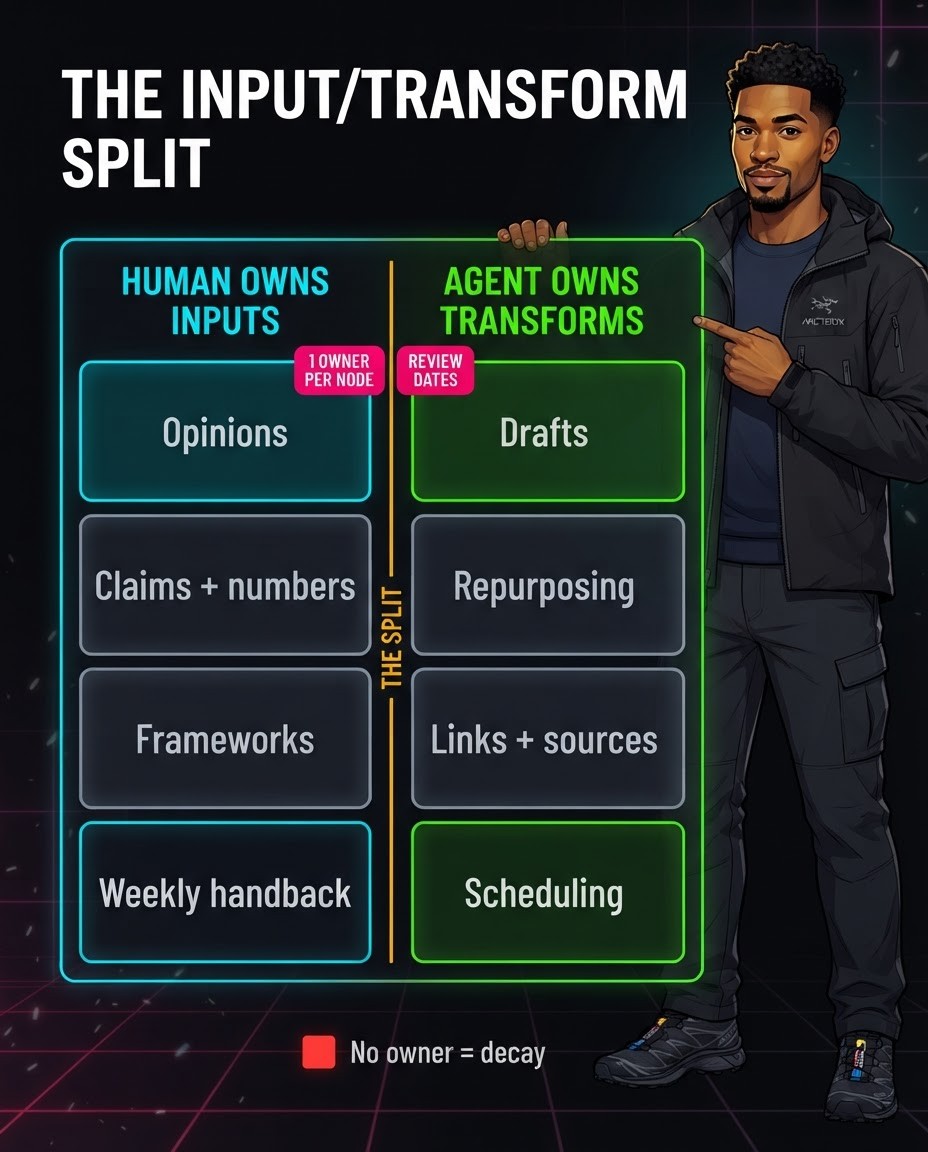
The split that keeps a draft yours: you own the inputs (opinions, claims, frameworks), and the AI owns the transforms (drafts, repurposing, scheduling).
How do you build a voice guide with AI?
Give the model real examples of your writing, ask it to describe them, then turn that description into positive instructions.
Anthropic's prompting best practices for Claude back each part of this. The docs advise telling the model "what to do instead of what not to do," explaining the reason behind an instruction because "Claude can generalize from the explanation," and using examples, which they call "one of the most reliable ways to steer Claude's output format, tone, and structure." They suggest 3 to 5 examples for best results.
Prompt 1: extract the voice
Below are 10 LinkedIn posts I wrote. Describe how I write so another writer could match it: sentence length and variation, openers, endings, words I use often, words I never use, how I use numbers and my stance on my topics. Quote short examples. Describe only. Do not praise.
Prompt 2: turn it into instructions
Turn this description into a voice guide of under 300 words. Phrase each rule as what to do, with the reason. Then pick the 3 posts that best show the voice.
Prompt 3: draft from the brief
Using the voice guide and the 3 example posts, draft a LinkedIn post from my notes. Use only facts, numbers and stories from my notes. If a point needs a fact I did not give, ask me for it in brackets instead of inventing one. My notes follow.
Business writing tools follow the same logic. Writer's help center says style guide and term settings "do not affect WRITER Agent outputs on their own" until you connect them to a voice.
What should you never hand to AI?
Stories, opinions and numbers. A model cannot know any of them, so it fills the gap with plausible fiction.
Stories. Any anecdote the model writes is invented. Write the event yourself, even in rough notes, and let AI tidy the sentences.
Opinions. A model trained to be agreeable lands in the middle of every debate. The take that makes a post worth sharing has to be yours.
Numbers. Every figure needs a source you have opened. AI will produce a convincing statistic with no source behind it.
The first line. The hook decides whether anyone reads the rest. Write it last, by hand, from the strongest fact in the post.
Specific numbers and named sources also help a post travel beyond your feed, the subject of the guide on getting cited by ChatGPT and Perplexity.
Sponsored posts raise the stakes, because a brand is paying for your audience's trust. The guide on B2B creator sponsorships covers how those deals work.
I hold my published bylines to the same rule as my posts: AI can arrange my material, but it cannot supply it.
Three jobs stay human no matter how good the model gets: the signature, the standard and the read.

What does a before and after edit look like?
Here is an illustrative AI paragraph, written for this guide:
"In the fast-paced world of B2B marketing, content is not just a nice-to-have, it's a crucial growth driver. By using AI, teams can create engaging, authentic and impactful posts. Ultimately, the brands that win will be the ones that embrace this shift."
The edit, built from the writer's own notes:
"Our team posts three times a week. AI writes the first draft from my notes in about ten minutes, and I spend twenty minutes cutting it. The posts I rewrite most get the most replies."
The edit drops the era opener, the contrast, the adjective list and the prediction, and adds an observation only the writer could make. The figures are illustrative; use your own.
What should you check before you publish?
The main claim and every opinion came from your notes, not the draft
Every number links to a source you opened, or is labeled as an illustration
No anecdote in the post was written by the model
You wrote the first line yourself
No "It's not X, it's Y" or "not only X, but also Y" constructions, or one at most, used on purpose
Each list holds only the items you can back up
Sentence length varies, and at least one short sentence lands after a long one
No stacked hedges or unnamed "studies"
The last line adds something new instead of summarizing
You read it aloud and it sounds like you talking
What are the common mistakes when editing AI drafts?
The biggest is editing the words and skipping the substance.
Starting from a blank prompt. "Write a post about X" returns the average take on X. Start from your notes.
Banning words and calling it done. The overused list keeps shifting, and readers also judge originality and clarity, per the Russell study.
Swapping synonyms. Changing "crucial" to "vital" keeps the empty sentence. Replace it with a fact or cut it.
Letting AI write the example. An invented customer story is the fastest way to lose a reader who later finds out.
Trusting a detector score. Wikipedia warns that detection tools "have non-trivial error rates." Edit for the reader.
Over-formatting. Bold labels on every bullet and a header over every two sentences read as generated. Use prose where prose works.
FAQ
Can AI writing ever sound human?
Yes, when the substance comes from a person. Feed the model your notes and edit the draft by hand.
What words give away AI writing?
Research and Wikipedia's editors flag words such as "delve" and "showcasing," but the list changes as models change.
Do AI detectors work?
Not well enough to trust alone. Wikipedia's editors say the tools "perform better than random chance" but have non-trivial error rates.
How many past posts do I need for a voice profile?
Ten is a workable base for the profile. Anthropic's docs suggest 3 to 5 examples inside the prompt itself.
Should I tell readers I used AI?
Follow the platform's rules and any sponsor agreement. Either way, every claim in the post should be yours and true.
Is it fine to use em dashes now?
Wikipedia's editors now file heavy em dash use under historical signs, because newer models are often built to avoid the dash. I leave it out of my own writing and use a comma, period or parentheses.
Want help building the writing system behind this?
I work with a small number of B2B teams as a fractional GTM and AI engineer, setting up the drafting workflows this guide describes, from the voice guide to the scan that runs before anything ships. If you want help putting one in place, see how I work or book a short intro call. Brands asking about sponsored content can use the same contact page.
Running revenue at a Series A or B SaaS company? Ask about the 90-day AI RevOps Sprint. I take two clients at a time.
About the author: Kevin Payne is an AI engineer and GTM operator who installs AI workflows for B2B teams. He has 10+ years in B2B SaaS demand generation and RevOps across Techstars, a16z and YC portfolio companies, and his writing has appeared in HubSpot, GetResponse, Outbrain and more.