How to get cited by ChatGPT and Perplexity

Let the AI search crawlers in, write each page as a direct answer to one question, and get your brand named on the third-party pages those engines already cite. Then track a fixed set of prompts every month. ChatGPT, Perplexity and Google each document a search crawler that decides which sites can appear, so search basics still apply.
This guide is part of the B2B creator-operator playbook.
Key points
OpenAI says OAI-SearchBot is the crawler that surfaces sites in ChatGPT search, and Perplexity says the same of PerplexityBot. Block them and you opt out.
Google says there are no extra requirements, special schema or AI text files needed to appear in AI Overviews or AI Mode.
A page built as a question, a short answer, question subheadings, tables and an FAQ is easy for an engine to quote.
Off-page mentions on lists, publications, forums and review sites decide whether your brand appears in answers about your category.
Measure with a fixed prompt list, either by hand or with a tracker such as Profound, Otterly.AI, Peec AI or Semrush.
How do ChatGPT and Perplexity choose which sources to cite?
Both search the live web, read the pages they find and link the ones they use. Neither publishes a ranking formula, so the official docs cover eligibility only.
Engine | Crawler that controls search inclusion | What the official docs say | Your control |
|---|---|---|---|
ChatGPT search | OAI-SearchBot | OpenAI's crawler docs say it "is used to surface websites in search results in ChatGPT's search features" | Allow or disallow OAI-SearchBot in robots.txt |
Perplexity | PerplexityBot | Perplexity's crawler docs say it "is designed to surface and link websites in search results on Perplexity" | Allow or disallow PerplexityBot in robots.txt |
Google AI Overviews and AI Mode | Googlebot | A page "must be indexed and eligible to be shown in Google Search with a snippet" | Googlebot rules in robots.txt, plus nosnippet, max-snippet or noindex |
OpenAI's ChatGPT search help page adds that ChatGPT responses using search "will contain inline citations," and that it may share "disassociated search queries with third-party search providers such as Bing."
Perplexity's help center says "each answer includes numbered citations linking to the original sources."
Each engine also has a user-triggered fetcher (ChatGPT-User and Perplexity-User). OpenAI says ChatGPT-User does not determine whether content appears in search, so the search crawler is the setting that counts.
Can AI search crawlers reach your site?
Check this first, because a blocked crawler cancels everything else. Open yourdomain.com/robots.txt and look for rules naming OAI-SearchBot, PerplexityBot or Googlebot, or a blanket block on every bot.
Search and training are separate settings. OpenAI's docs say a site can allow OAI-SearchBot for search while disallowing GPTBot, which governs whether content is used to train foundation models. Perplexity says PerplexityBot "is not used to crawl content for AI foundation models." So you can stay out of training data and still be citable.
A minimal robots.txt that allows search crawlers and declines OpenAI training looks like this:
Three practical notes:
Allow time. OpenAI says its systems take about 24 hours to adjust after a robots.txt update. Perplexity gives up to a day.
Check your CDN and firewall. Google tells site owners to allow crawling in robots.txt "and by any CDN or hosting infrastructure." OpenAI and Perplexity both publish IP ranges you can allowlist.
Keep content in text. Google recommends keeping important content in textual form, not locked inside images.
What does an AEO-ready page look like?
It reads like an answer before it reads like an article. The format of this guide is a worked example: a question as the H1, a 40 to 60 word answer directly under it, standalone bullet points, follow-up questions as H2s, tables and an FAQ.
The answer-first template
Element | What to do | Why it helps an engine |
|---|---|---|
Question H1 | Use the exact question a buyer would type or say | Matches the prompt the engine is answering |
Answer block | 40 to 60 words, no lead-in, directly under the H1 | Gives the engine a complete, quotable answer |
Key points | 3 to 5 bullets that each stand alone | Each bullet survives being lifted out of context |
Question H2s | Each opens with a one or two sentence direct answer | Covers the follow-up questions in the same session |
Tables | Comparisons, prices, specs, criteria | Puts facts in rows an engine can read cleanly |
Named sources | Link the primary source next to each figure | Makes your claim checkable and your page a better citation |
FAQ | Six real questions with short answers | Catches long-tail phrasings of the topic |
Author and date | Named author, bio and a visible last-updated date | Shows who stands behind the page and how fresh it is |
There is research behind the sourcing advice. A study that introduced the term generative engine optimization, the GEO paper by Aggarwal and co-authors, reports that its methods "can boost visibility by up to 40%" in generative engine responses. In its results, adding quotations, adding statistics and citing sources were the strongest methods, while keyword stuffing scored below the unoptimized baseline on its main visibility measure.
The study ran on its own test engine and queries, so treat it as direction for ChatGPT and Perplexity rather than a guarantee.
If you draft answer blocks with AI, edit them hard, because generic phrasing makes a page interchangeable with every other page on the topic. The guide on writing with AI without sounding like AI covers the edit pass.
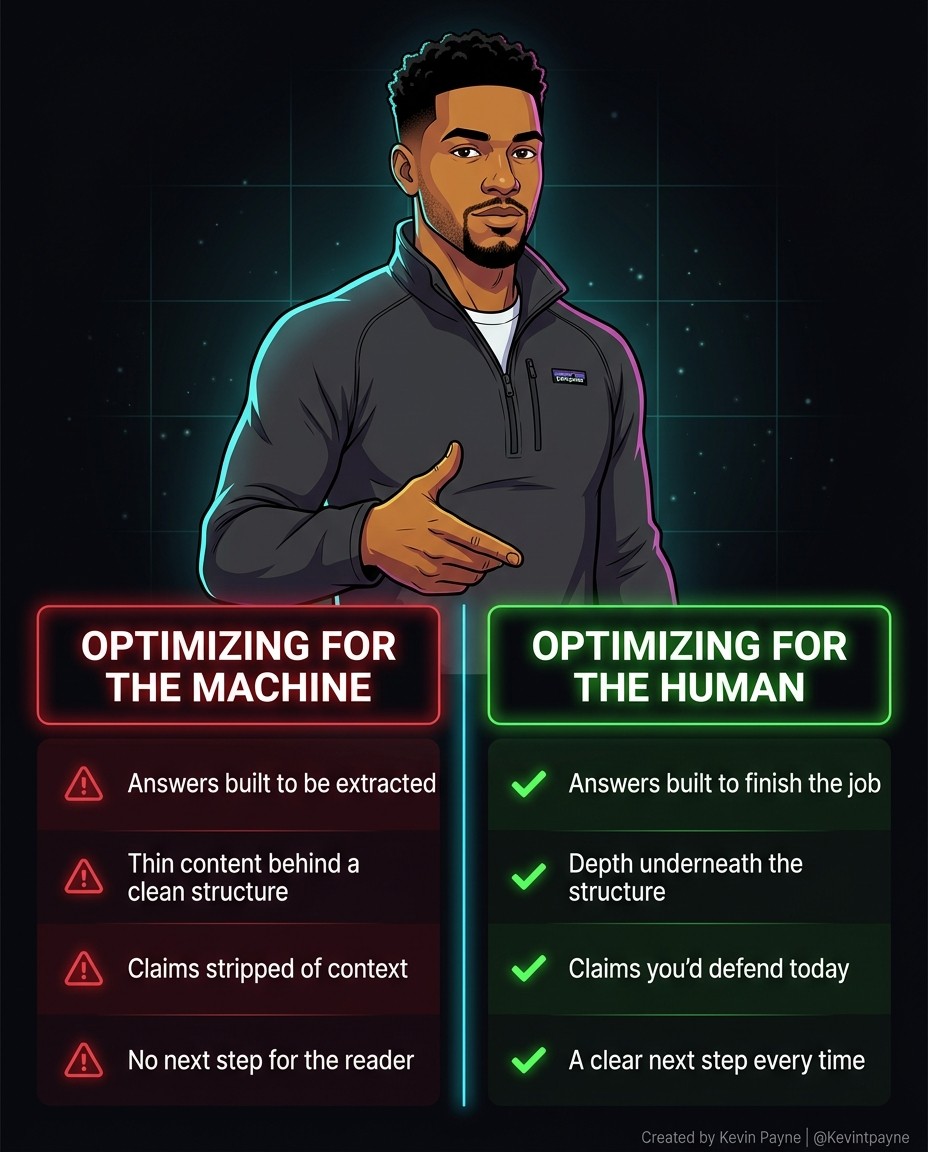
Write for both readers at once: a clean structure the machine can extract, and enough depth that the person reading it can finish the job.
Does llms.txt or special schema get you cited?
No. Google states that "you don't need to create new machine readable files, AI text files, or markup to appear in these features," and that there is "no special schema.org structured data that you need to add."
My view is that llms.txt is not used by AI search engines to choose sources, so it does not belong on a citation plan. None of the crawler docs from OpenAI or Perplexity cited here asks for it.
Structured data still helps normal search features, as long as it matches the visible text on the page, which is Google's stated condition.
How do off-page mentions get your brand into AI answers?
When someone asks "what are the best tools for X," the engine reads pages that answer that question. If your brand is not named on those pages, your own site cannot fix it.
Run your category questions through ChatGPT and Perplexity and open every cited source. That list is your target map of publications, comparison posts, forums and review pages.
Digital PR and contributor articles
Pitch data, expert quotes and original frameworks to the publications that repeat in your target map. A contributor article or a roundup quote puts your name on a page the engine already reads. My own writing has appeared in HubSpot, GetResponse, Outbrain and more, and each byline is a third-party page with my name on it.
Guest posts on relevant sites
Guest posts work when the host site covers your topic and the post answers a real question. Match each post to one question from your prompt list.
"Best of" lists and comparison pages
Lists of the best tools or agencies in a category answer buying questions directly, so check which ones appear in your target map. Ask authors to review your product, offer an honest comparison table and correct outdated entries about you.
Reddit, communities and forums
Answer questions in the communities your buyers use, under your own name, and disclose when you mention your own product.
Reviews and sponsored content
Review platforms and marketplace listings name your brand next to your category. Sponsored creator posts can do the same on social platforms, and the guide to LinkedIn sponsored post rates covers what those placements cost. Disclose every paid mention.
How do you measure whether AI engines cite you?
Pick a fixed list of prompts, run them on a schedule and log whether your brand is mentioned, whether your site is cited and which sources appear, by hand or with a tracker.
Tools that track AI citations
Tool | What its own site says it does | Engines named | Listed price |
|---|---|---|---|
"See what your customers ask AI, deploy agents to act on it, and measure the results" | ChatGPT, Perplexity, Claude, Gemini, Microsoft Copilot, DeepSeek, Google AI Overviews | Not on homepage | |
Tracks brand mentions and website citations, with prompt research and competitor benchmarking | Google AI Overviews, Google AI Mode, ChatGPT, Gemini, Microsoft Copilot, Claude, Perplexity | From $29 a month | |
Tracks visibility ("the share of chats where your brand is mentioned"), position and sentiment | ChatGPT, Perplexity, Gemini, plus an AI Mode tracker | Not on homepage | |
Shows "how brands appear in AI-generated answers," tracks prompts daily and audits sites for AI crawler blockers | Google AI Mode and ChatGPT named in its knowledge base | $99 a month |
A manual method that costs nothing
Write 20 to 30 prompts that a buyer would ask, split between category questions ("best tools for X") and problem questions ("how do I fix Y").
Run each prompt in ChatGPT with search and in Perplexity, in a fresh session.
Log three fields per answer: brand mentioned (yes or no), your URL cited (yes or no) and the top three cited domains.
Repeat monthly with the same prompts so the numbers compare.
As an illustrative example with round numbers: a brand named in 3 of 30 answers in month one and 9 of 30 in month four has moved from a 10% to a 30% mention rate. The cited-domain column shows which publications to pitch next.
This recurring check is a good first loop to automate, and the guide on loop engineering for AI workflows shows how to build scheduled checks that log results.
A citation log is a small reporting pipeline, and reporting is the operator side of my work. I build these systems behind my own content, and I build the revenue version for SaaS teams, covering lead routing, CRM cleanup and pipeline reporting, in a 90-day AI RevOps Sprint for Series A and B SaaS. Contact me to get yours scoped.
What is the checklist for getting cited?
The first three are technical gates.
Audit robots.txt for OAI-SearchBot, PerplexityBot and Googlebot, and remove any block on them.
Check your CDN or firewall for bot rules too.
Confirm indexing in Google Search Console, since Google requires a page to be indexed and snippet-eligible.
Build your prompt list of 20 to 30 buyer questions.
Map the cited sources for each prompt and note the publications, lists and forums that repeat.
Rewrite your top pages with a question H1, a 40 to 60 word answer, question H2s, a table and an FAQ.
Add a named source next to every figure.
Pitch three publications from your source map each month.
Request inclusion or corrections on the "best of" lists in your category.
Re-run your prompts monthly and log mentions, citations and cited domains.
What are the common mistakes?
The most common mistake is blocking the search crawlers while trying to block training.
Blocking every AI bot. A blanket block on OpenAI or Perplexity agents also removes you from their search results. Block GPTBot if you want, and allow OAI-SearchBot.
Forgetting the CDN. Bot protection can block crawlers robots.txt allows.
Burying the answer. A 300-word intro before the answer gives the engine nothing to quote.
Writing llms.txt instead of content. Google says no AI text files are needed, and the engines cited here do not ask for one.
Keyword stuffing. The GEO paper found it scored below baseline on its main visibility measure.
Ignoring third-party pages. If the cited lists for your category skip you, on-page work alone will not get you in.
Checking once. Answers change, so keep a monthly log.
FAQ
How long does it take to get cited by ChatGPT?
Crawler access changes take about a day, per OpenAI. Earning mentions on third-party pages takes months of steady pitching and publishing.
Does blocking GPTBot stop my site from appearing in ChatGPT search?
No. OpenAI says the settings are independent. GPTBot covers model training, and OAI-SearchBot covers ChatGPT search.
Do I need an llms.txt file to appear in AI answers?
No. Google says you do not need AI text files or special markup for AI Overviews or AI Mode, and none of the OpenAI or Perplexity crawler docs cited here ask for one.
Is AEO different from SEO?
It builds on SEO. Google requires pages to be indexed and snippet-eligible, so AEO adds answer-first formatting and off-page mentions to search basics.
Which tool is best for tracking AI citations?
It depends on the engines you care about. Otterly.AI and Profound each name seven engines, Otterly.AI starts at $29 a month, Semrush's toolkit is $99 a month, and Peec AI tracks visibility, position and sentiment.
Can I pay to get cited by ChatGPT or Perplexity?
Neither OpenAI's nor Perplexity's crawler docs describe a paid route into search citations. You can pay for disclosed sponsored content and PR, which puts your brand on pages the engines may read.
Want help getting your brand into AI answers?
I work with a small number of B2B teams as a fractional GTM and AI engineer, building the content, mention and tracking systems this guide describes, from answer-first page templates to monthly citation logs. If that would help, see how I work or book a short intro call. Brands asking about sponsored content can use the same contact page.
Running revenue at a Series A or B SaaS company? Ask about the 90-day AI RevOps Sprint. I take two clients at a time.
About the author: Kevin Payne is an AI engineer and GTM operator who installs AI workflows for B2B teams. He has 10+ years in B2B SaaS demand generation and RevOps across Techstars, a16z and YC portfolio companies, and his writing has appeared in HubSpot, GetResponse, Outbrain and more.