How to Stand Out in a GTM Engineer Interview: Run an Audit as Your Take-Home

Bring a one-page audit of the hiring company's public go-to-market motion. Research their site, pricing, job posts and reviews, test the inbound path with honest details, map the manual work it likely creates, put an illustrative cost on it, and propose three ranked builds. Present it in ten minutes, then answer their questions.
Key points
Most candidates only answer questions. An audit shows you can find a problem, size it and propose a fix before anyone asks.
Use public signals only: website, pricing page, demo form, chat widget, job posts and review sites.
Test the inbound path with your real name and a clear note that you are a candidate. Never submit fake leads.
Cost each leak with simple, labelled assumptions, then rank three builds by value and effort.
Keep it to one page and ten minutes. The conversation it starts matters more than the document.
Why does an audit beat a standard interview answer?
Because it shows the job instead of describing it. A GTM engineer finds where revenue work leaks and builds systems to stop it, and an audit is a small version of that work done on the company's own funnel.
If you are still deciding whether the role fits, the guide to becoming a GTM engineer covers the path and skills.
Hiring guidance from the people who shaped the role points the same way. Clay's guide to hiring a GTM engineer, written by Julia Govberg, says "The best GTMEs are hybrids: part commercial thinker, part builder." It also lists red flags, including "Lack of commercial awareness: Focusing purely on technical implementation without connecting to business outcomes."
An audit answers that concern, because every finding ties a system gap to a business cost.
Jan Berning, Head of Growth at Databar, makes a similar case in how to hire a GTM engineer in 2026: "A short paid take-home that mirrors a real campaign workflow predicts on-the-job performance better than any whiteboard exercise." If the company does not set a take-home, you can bring your own.
What does a hiring manager actually look for?
They want proof you can work from a vague brief, connect systems to revenue, and choose the simple fix first. Your audit should show all three.
Liz Christo's Stage 2 Capital post, Do You Need a GTM Engineer?, follows one hiring process at Arda. Arda founder Kyle Henson ended the job post with "the best candidates will likely proactively figure out how to get our attention." The final step was a paid project where "the prompts were vague on purpose."
The candidate who got the job found a sequence that excluded its own audience, a reply with no follow-up trail, and dormant contacts worth routing into trials. He also pushed back on one requested campaign with a clear reason. That is the shape of a good audit: real findings, a fix for each, and judgment about what not to build.
What interviewers tend to score:
Commercial thinking. Do you tie each issue to pipeline, speed or cost?
Diagnosis. Do you explain how you found the problem and what you assumed?
Simplicity. Clay's guide flags "Over-engineering: Jumping straight to complex solutions without considering simpler approaches first."
Trade-offs. Do you show alternatives, or push one tool for everything?
Writing. Berning notes "Most GTM work is words, not code." A clear page is part of the test.
For the full list of skills behind these signals, see the GTM engineer skills matrix.
How do you research the company from public signals?
Spend about two hours reading what the company already publishes about its go-to-market motion. You are looking for how they attract, capture, route and follow up with buyers.
Work through these sources in order:
Homepage. Who is the buyer, and is the main call to action a demo, a trial or a contact form?
Pricing page. Is pricing public, gated behind a call, or tiered by seats? Gated pricing usually means more inbound conversations to qualify.
Demo or contact form. Count the fields and note which are required.
Chat widget. Is there one? Does it route to a person, a bot or a booking link?
Job posts. Sales, SDR and RevOps listings often name the CRM, enrichment tools and sequencing platform.
Review sites. Look for repeated complaints about response speed or handoffs.
The company's own content. Blog posts, webinars and the founder's public posts often say what the team is trying to grow next.
Write down every fact with its source. You will cite them in the interview, and "your SDR job post lists these three tools" lands far better than a guess.
How do you test the inbound path ethically?
Submit the main demo or contact form once, with your real name and email, and say in the message field that you are a candidate researching their inbound process and need no sales follow-up. Then record what happens and when.
Why the inbound path matters: it is the most visible part of the motion and often the leakiest. The idea has a long history. Harvard Business Review published The Short Life of Online Sales Leads by James B. Oldroyd, Kristina McElheran and David Elkington in 2011, and response speed has been studied regularly since.
Recent studies show how wide the gap still is:
Workato's study. In a test of 114 B2B companies' lead response times, Anusha Kuppahally reports that only 1 of 114 sent a personalized email within 5 minutes. The average time to that type of response was "11 hours and 54 minutes."
Clay's experiment. In Clay's speed-to-lead experiment, run by Alex Lindahl, agents submitted 6,346 demo and contact forms. Only 32% got an email reply, and 5% of replies came within five minutes.
Clay's experiment used one made-up buyer at research scale, and the post cautions that "A non-reply doesn't mean a lack of diligence or care." For an interview, one honest submission is the right size.
Treat your result as one data point, not a verdict. HubSpot defines lead response time as how quickly "your sales team follows up with new prospects after they express interest," and a candidate note may be routed differently from a real buyer.
Ethics rules for the audit
No fake leads. Use your real identity and say why you are there.
One submission. Do not spam forms, chats or phone lines.
Do not book a rep's time. If a scheduler appears, note it and close the page.
Public pages only. No scraping behind logins and no trial accounts created under false pretenses.
Tell them what you did. Open the presentation by saying exactly how you tested and what you sent.
Be kind about findings. The people interviewing you may have built this funnel.
What should you test on their GTM motion?
Use a short checklist so your findings are consistent and easy to compare. Mark each item as working, slow, missing or unclear.
Main call to action is clear within one screen of the homepage
Form asks only for fields the team will actually use
Form confirms submission and sets an expectation for reply time
Auto-reply arrives, and how long it takes
First human reply arrives, and how long it takes
Reply references what you wrote, or is a generic template
Chat widget answers a simple pricing question correctly
Pricing page answers the first three buyer questions
Job posts reveal the tools in the stack
Reviews mention sales or onboarding friction more than once
Keep timestamps. "Auto-reply in 2 minutes, no human reply after 48 hours" is a finding. "Seemed slow" is not.
A quick way to sort what you find: inventory the recurring tasks, ask three questions of each, then mark it keep, conditional or delegate.
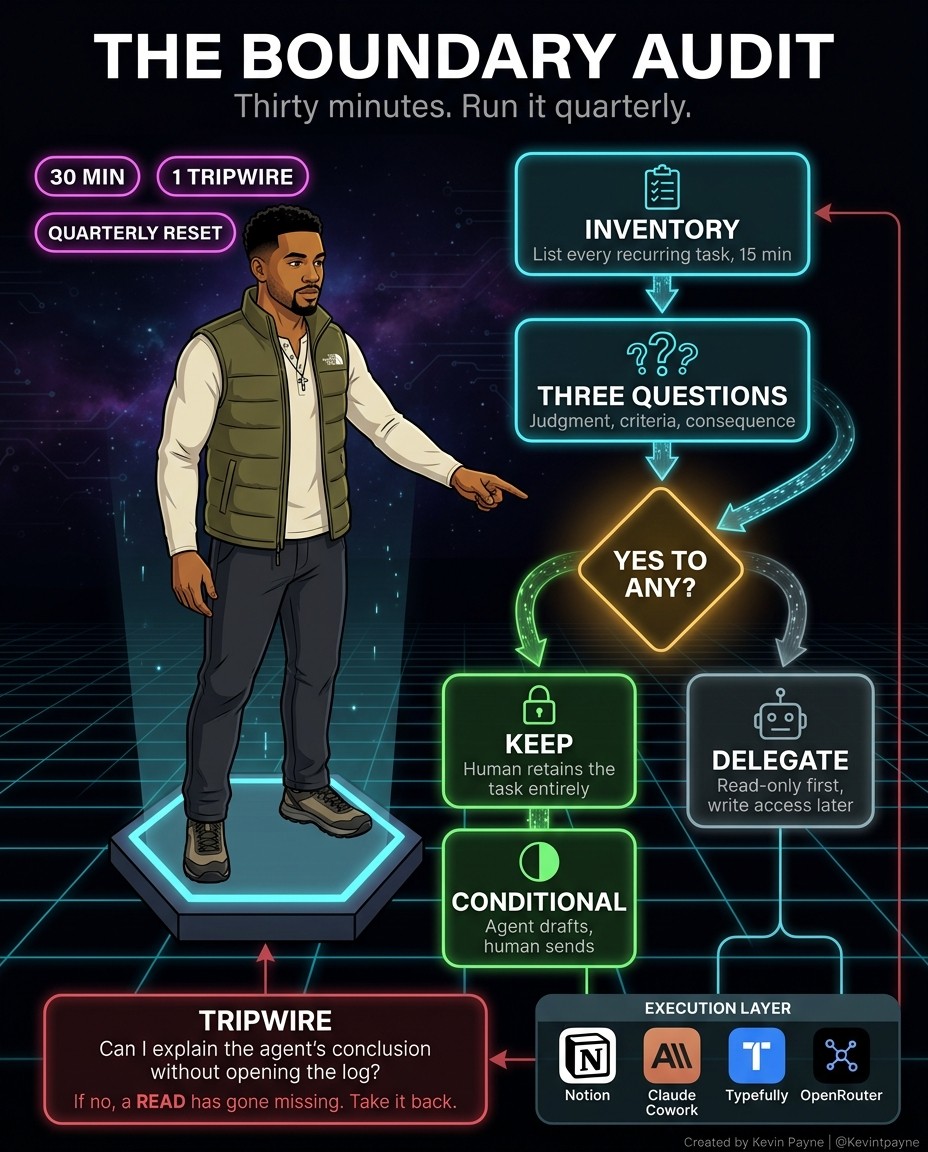
How do you map the manual work and estimate the cost?
For each finding, describe the manual work it probably creates, then put an illustrative yearly cost on it using leak audit math. Label every number as an assumption you would confirm in the job.
The formula comes from the manual-work leak audit: runs per week x minutes per run, converted to hours, x loaded hourly rate x 52.
Here is an illustrative example with round hypothetical numbers:
Assumption | Value |
|---|---|
Inbound demo requests per week | 100 |
Minutes of manual research and routing per request | 6 |
Hours per week (100 x 6 / 60) | 10 |
Loaded hourly rate | $60 |
Illustrative yearly cost (10 x $60 x 52) | $31,200 |
Say plainly that you picked round numbers to show the method. Interviewers care more that you can size a leak than whether your guess is right.
Then add the cost of slow follow-up in words, not invented dollars. "If replies take a day, some buyers will book with a competitor first" is honest. A made-up conversion rate is not.
How do you pick and rank the three builds?
Propose three builds, ranked by value and effort, each tied to a finding. Three is enough to show range without turning the meeting into a roadmap review.
Score each one on three questions: how much of the illustrative cost it removes, how rule-based the work is, and whether it uses tools they already pay for. The highest score goes first.
Example builds that often fit an inbound audit:
Instant enrichment and routing. When a form is submitted, enrich the company, score fit and assign an owner with a Slack alert. Mostly rules, so it is cheap and predictable.
First-reply drafting with approval. An agent researches the company and drafts a personalized reply that a rep approves before it sends. The guide to AI chat agents for inbound lead qualification covers where approval steps belong.
Follow-up for no-replies. A sequence that catches leads with no human touch after a set time and flags them to a manager.
For each, give the trigger, the tools, the human check and how you would measure it. Mention which level of automation you would start at; the AI automation maturity ladder is a useful frame for keeping a person in the loop early.
What does a one-page audit template look like?
Fit everything on one page so the interviewer can read it in two minutes. Use this structure:
Section | What to include |
|---|---|
Header | Company, date, your name, one line on how you tested |
Motion summary | Buyer, main call to action, pricing model, stack seen in job posts |
Inbound test | Time submitted, auto-reply time, first human reply time, personalization |
Top three findings | One line each, with the public source |
Manual work map | Likely manual steps behind each finding |
Illustrative cost | Formula, round assumptions, yearly figure, labelled as illustrative |
Three builds ranked | Build, trigger, tools, human check, metric, effort |
Questions for them | Three things you would need to confirm in the first month |
The last row matters. Ending on questions turns the audit into a working session, which is what most hiring loops are trying to simulate.
Keep a trail as you research: scope, notes, the artifacts you collect and the proof behind each finding. In the interview, the trail becomes the pitch.

How do you present the audit in ten minutes?
Spend one minute on method, seven on findings, cost and builds, and two on questions. Send the page ahead of time or bring it as a shared doc.
A simple running order:
Minute 1. How you tested and what you submitted.
Minutes 2 to 4. The three findings, each with its source and timestamp.
Minutes 5 to 6. The illustrative cost and how you would confirm it.
Minutes 7 to 8. The three builds, ranked, with the first one explained in detail.
Minutes 9 to 10. Your questions, then theirs.
Expect pushback. If they say a finding is wrong, ask what you missed and adjust live. Stage 2's post makes the point that judgment under a vague brief is the real test, and how you handle being corrected is part of it.
What are the most common mistakes?
The biggest mistake is turning the audit into a critique of their team. Most of the others come from inventing data or showing too much.
Fake form submissions. It is dishonest and it can damage their pipeline data. Use your real details.
Invented numbers. Present every figure as an illustrative assumption unless it came from a public page.
Tone that blames. Describe gaps as normal growth problems, because they usually are.
Tool-first pitches. Lead with the problem and the cost. Name tools last.
Twelve pages. One page, three findings, three builds.
No trade-offs. Say what you would not build yet, and why.
FAQ
Should I send the audit before the interview?
Yes, if you have a contact who agreed to receive it. Otherwise bring it and ask at the start whether they want to see it.
What if the company already set a take-home?
Do theirs first and do it well. You can add a short appendix with one inbound finding if it fits the brief.
Is it okay to fill out their demo form?
Once, with your real name and a note that you are a candidate. Never use a fake identity or book a rep's time.
How long should the audit take?
About half a day of work: two hours of research and an hour to write the page, plus a day or two waiting for replies.
What if I find nothing wrong?
Then say what works and why, and propose builds that would scale it. A clean funnel still has manual steps behind it.
Does this work for RevOps or sales ops interviews too?
Yes, with a different focus. The comparison of GTM engineer, RevOps and sales ops roles explains which findings each role cares about most.
Get help preparing your GTM engineer interview
If you want a second pair of eyes on your audit or your interview plan, book an intro call and we can walk through it together. If you are a hiring manager who wants the same audit run on your own team, start with the free Leak Call.
About the author: Kevin Payne is an AI engineer and GTM operator who installs AI workflows for B2B teams. He has 10+ years in B2B SaaS demand generation and RevOps across Techstars, a16z and YC portfolio companies, and his writing has appeared in HubSpot, GetResponse, Outbrain and more.