How Should AI Automation Consultants Charge? The Case for Performance-Based Pricing

AI automation consultants should price against the result, not the hours. For most projects that means a fixed fee scoped to one workflow, or a performance-based fee set as a share of measured time or cost saved. Performance pricing needs a clean baseline, a floor that covers your costs and a cap the buyer can budget for.
Key points
Hourly billing pays you less the faster your automation works, which is the opposite of what the client wants.
Software vendors already charge for AI by outcome, such as per resolved conversation, so buyers are getting used to the idea.
A performance fee is only as fair as its baseline. Measure the manual hours before you build anything.
Pair any share of savings with a floor and a cap, so neither side carries all the risk.
Performance pricing is a bad fit when you cannot measure the result, or when the client controls whether it happens.
What are the five ways to charge for AI automation work?
There are five common models: hourly, fixed project, retainer, value-based and performance-based. Each one shifts risk and reward differently between you and the buyer.
If you are new to how these projects fit together, start with the guide to what an AI operating system is for a B2B team. Pricing is easier once you know whether you are selling one workflow or a shared layer that many workflows run on.
Model | How it works | Pros | Cons | When it fits |
|---|---|---|---|---|
Hourly | You bill for time spent | Simple to quote, low risk for you | Pays you less as you get faster, buyer cannot budget | Short advisory calls, undefined discovery |
Fixed project | One price for a defined scope | Buyer knows the cost up front, you keep efficiency gains | Scope creep, you carry overrun risk | One workflow with clear inputs and outputs |
Retainer | Monthly fee for ongoing access or upkeep | Predictable income, covers maintenance | Can drift into paying for availability, not output | Running and tuning workflows after launch |
Value-based | Fee set by your contribution to the value the buyer agrees to | Ties price to business impact | Needs a value conversation many buyers skip | Projects with a clear, agreed business outcome |
Performance-based | Fee is a share of measured time or cost saved | Strongest alignment, easy to justify | Needs a baseline and tracking, payment arrives later | Repetitive workflows with countable hours |
Value-based and performance-based pricing look similar. The difference is timing. A value-based fee is agreed up front from projected value. A performance fee is calculated from what you actually measure after launch.
Why does hourly billing fit AI automation so badly?
Because the whole point of automation is to remove hours, and hourly billing pays you for hours. The better your build, the smaller your invoice.
Jonathan Stark makes this case in Hourly Billing Is Nuts. He argues that hourly billing "encourages mistrust in the client because the financial incentives of the two parties are misaligned." He also calls hours "arbitrary units of measure that have nothing whatsoever to do with the outcome of the work."
Alan Weiss goes further. In his paper The Case for Value Based Fees, he defines a value-based fee as "a fee that is based on your contribution to the results the client achieves." He also writes that "The client is best served when issues are resolved and improved quickly," which time-based billing works against. AI sharpens the point: when Claude drafts a workflow's logic, a week of build can shrink to a day, and under hourly billing that speed is a pay cut.
To be fair to hourly billing, it still has a place:
Paid discovery. When nobody knows the scope yet, a few billed hours are honest.
Advisory calls. A one-hour review of someone else's build has no clean outcome to price.
Unbounded fixes. Debugging a client's existing setup, where the cause is unknown.
What is performance-based pricing for AI automation?
Performance-based pricing means your fee is a share of a result you can count, such as hours saved, cost removed or tasks completed. You get paid more when the workflow works better, and less when it does not.
Software vendors are already pricing AI this way. Intercom's Fin pricing page lists "$0.99 per outcome," and its FAQ says "You're not charged when a conversation is simply passed to your team without an outcome." A resolution counts when "No further help is requested after Fin's last answer."
Salesforce's Agentforce pricing page lists $2 per conversation alongside a credit-based option. That is a unit closer to output than a seat license is.
Large consulting firms are moving the same way. Business Insider reported that about a quarter of McKinsey's global fees now come from outcomes-based pricing, quoting UK managing partner Michael Birshan: "We're doing more performance-based arrangements with our clients." Buyers now see outcome pricing on their own software bills, so a proposal priced on results no longer looks strange.
How do you price a project as a share of time saved?
Measure the yearly cost of the manual work, pick the workflow you will automate, then charge a share of the first-year savings. The share should leave the buyer with most of the gain.
Here is the worked example from my AI Workflow Install page. A 12-person team spends 8 hours per person per week on manual work, at a $60 loaded hourly rate.
Count the weekly hours. 12 people times 8 hours is 96 manual hours a week.
Convert to a yearly cost. 96 hours times $60 times 52 weeks is $299,520 a year.
Pick one workflow. In the example, one workflow accounts for half the total, $149,760 a year.
Set the share. As an illustrative range, 10 to 20 percent of first-year savings is $14,976 to $29,952.
Agree how savings are measured. Hours saved per week, checked against the baseline, at the same $60 rate.
Agree the payment schedule. For example, a floor at launch and the rest after a measured period.
The 10 to 20 percent range is illustrative, not a market standard. It is a starting point that keeps at least 80 percent of the first-year gain with the buyer, which makes the decision easy to defend internally.
What if the workflow only saves part of the time?
Then you charge on the part it saves. If the automation removes 30 of the workflow's 48 weekly hours, savings are measured on 30 hours, not 48. A finance team will accept that version.
Time saved is not always cash saved
A buyer only banks the money if the freed hours go to something else of value. Say this out loud in the proposal. Some buyers will still pay on hours freed, and some will want the fee tied to a harder number, such as contractor spend removed.
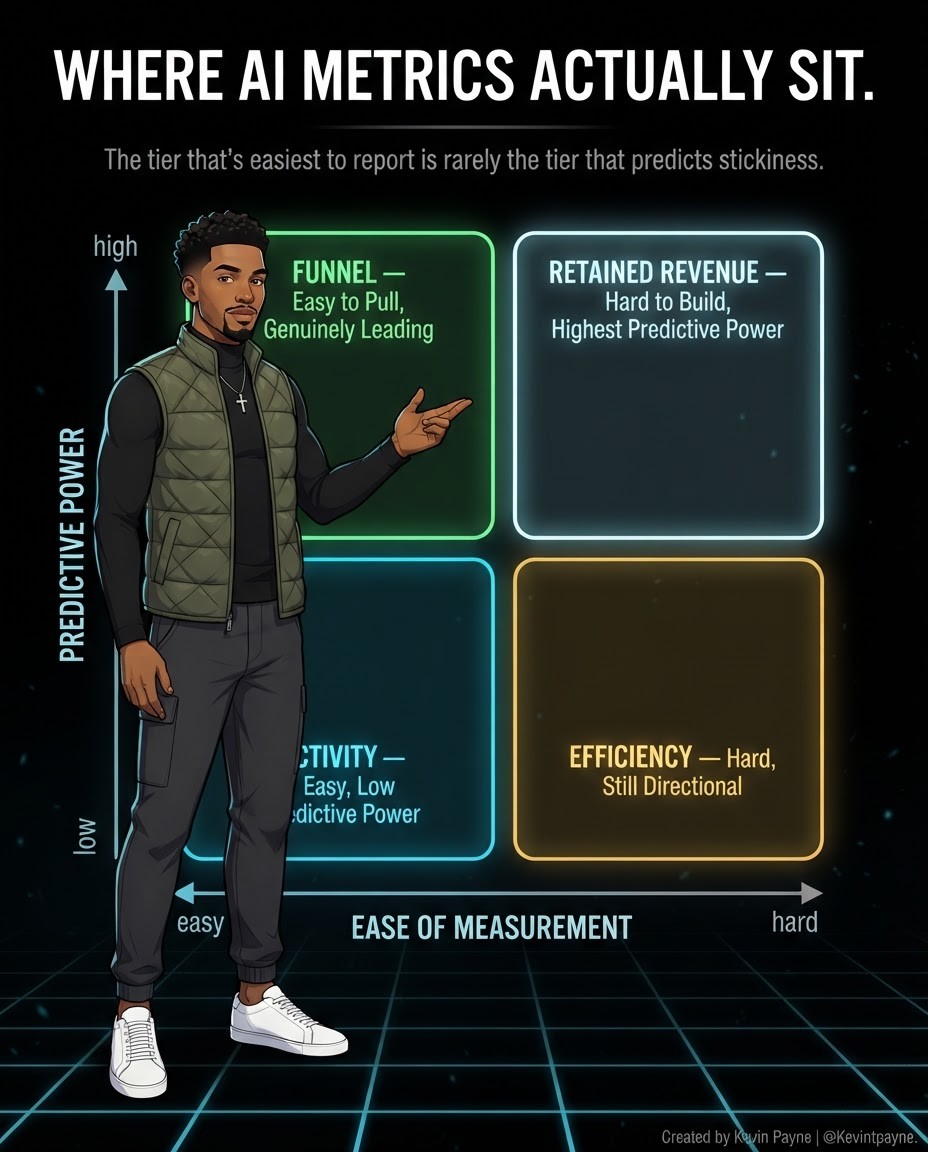
Pick the number you will be paid on carefully. The metrics that are easiest to report are rarely the ones that predict lasting value.
How do you measure the baseline before you start?
You time the manual work before you build, with the people who do it, over at least one normal week. Without a baseline, any performance fee turns into an argument.
The manual-work leak audit guide walks through the full process. The short version:
List the workflows. Every repeated task a team does by hand, such as copying lead data between tools or writing the same follow-up.
Time each one. Ask people to log minutes per task for a week, rather than guess.
Convert to yearly cost. Hours per week, times the loaded rate, times 52.
Rank by cost and clarity. The best first build is expensive and follows clear rules.
Sign off the numbers. Get the buyer to confirm the baseline in writing before work starts.
Step five matters most. Your fee depends on the baseline, so the buyer should own it.
After launch, measure the same way. If the workflow runs in n8n, its pricing page notes that billing is "based on monthly workflow executions, regardless of complexity," so the execution count gives you a clean run log. On Zapier, a task is "an action your Zap successfully completes," which also gives you a countable record. Run counts tell you the workflow ran. Timing a sample of runs against the old manual time tells you what it saved.
I think of performance terms as gates a workflow earns its way through: a documented manual baseline first, then instrumented feedback, contained failures and a named owner.

How should caps and floors work?
A floor protects you from doing the work for nothing. A cap protects the buyer from a fee they cannot budget. Most performance deals need both.
The floor
The floor is a fixed amount paid regardless of results, usually at kickoff or launch. It should cover your build time and tool costs, so a bad quarter for the client does not become a loss for you.
As an illustration, using the worked example above, a floor of $10,000 paid at launch with the rest earned from measured savings keeps you whole even if adoption is slow.
The cap
The cap is the most the buyer will ever pay, written into the contract. Finance teams approve a known maximum far more easily than an open percentage.
In the same illustrative case, a cap at 20 percent of the agreed baseline value, $29,952, means the buyer knows the worst case on day one.
The measurement window
Fix how long savings count. A first-year window is simple. A shorter window gets you paid sooner but needs annualizing, which invites dispute. Write the formula into the agreement.
When is performance-based pricing a bad idea?
When you cannot measure the result cleanly, or when the client controls whether the result happens. In those cases, a fixed fee is fairer to both sides.
Skip performance pricing in these situations:
No baseline exists. If nobody can say how long the task takes today, there is nothing to measure against.
Adoption is out of your hands. If the team can ignore the new workflow, your fee depends on their habits, not your build.
The result is shared. A pipeline lift that also depends on new hires or a price change cannot be split fairly.
The project is a shared layer. Building the knowledge base, permissions and logs that later workflows reuse saves little on its own. Price that as a fixed project.
You need the cash now. Performance fees arrive late. If that strains your business, do not offer them.
The buyer wants a fixed budget line. Some procurement teams cannot approve variable fees at all.
The AI automation maturity ladder helps here. A new agent workflow should start with a person approving every output, and that review time eats into savings early on. Price the early stage as fixed and move to performance terms once the workflow runs with less oversight.
What are the common mistakes when pricing AI automation?
The biggest mistake is quoting before measuring. Most of the others come from vague terms that leave the fee open to interpretation.
Quoting hours for an automation project. You end up paid for slow work and penalized for fast work.
Skipping the baseline. A share of unmeasured savings is a share of a guess.
Taking too large a share. If you claim most of the gain, the buyer has little reason to say yes.
No floor. A slow rollout on the client side should not mean unpaid work on yours.
No cap. An open-ended percentage scares finance teams and stalls the deal.
Counting runs instead of savings. A workflow can run a thousand times and save little if each run replaced a two-minute task.
Ignoring maintenance. Workflows break when apps change fields or prompts drift. Price upkeep as a separate retainer so the performance fee does not cover unpaid support.
On that last point, the guide to loop engineering for AI workflows covers how to keep a workflow improving after launch, which is the work a retainer pays for.
How do tool costs fit into the price?
Keep tool costs separate from your fee and say who pays them. The buyer should own the subscriptions, so the workflow keeps running if you leave.
Tool pricing also shapes what you can promise. n8n charges per full workflow run, Zapier counts each completed action as a task, and agent model usage varies with the steps per run. Show the monthly running cost alongside your fee. The comparison of Relevance AI, n8n and Zapier covers which fits which kind of workflow.
A simple proposal layout:
Floor fee. Paid at launch, covers the build.
Performance fee. A share of measured savings over the window, up to the cap.
Tool costs. Paid directly by the buyer, estimated per month.
Maintenance retainer. Optional, monthly, for upkeep after launch.
FAQ
What is the difference between value-based and performance-based pricing?
A value-based fee is agreed up front from the value both sides expect. A performance fee is calculated after launch from what you actually measure.
What percentage of savings should an AI consultant charge?
There is no standard. As an illustration, 10 to 20 percent of first-year savings keeps most of the gain with the buyer and is easy to approve.
Should I ever bill hourly for AI automation?
Yes, for paid discovery, short advisory calls or debugging a system you did not build, where there is no clean outcome to price.
How do I prove the time saved?
Time the manual work before the build, get the buyer to sign off the baseline, then time a sample of automated runs over the same period.
What if the client does not use the workflow?
Your floor covers your build. This is also why adoption risk is a reason to choose fixed pricing when the team may not change habits.
Do software vendors really price AI by outcome?
Some do. Intercom lists Fin at $0.99 per outcome, and Salesforce lists Agentforce at $2 per conversation.
Find out what your manual work is worth first
If you want a baseline you can price against, book a free 30-minute Leak Call. We estimate what manual work in one area costs per year, and you get a costed workflow list within 48 hours. You can also see all my offers on the services page.
About the author: Kevin Payne is an AI engineer and GTM operator who installs AI workflows for B2B teams. He has 10+ years in B2B SaaS demand generation and RevOps across Techstars, a16z and YC portfolio companies, and his writing has appeared in HubSpot, GetResponse, Outbrain and more.