How operators build a portfolio career

A portfolio career is a working life built from several income streams instead of one job title. For operators, that usually means paid consulting, content, advisory work, courses and a community, each sized to the time it takes and the revenue it returns. You manage it like an investment portfolio: some streams pay now, others compound.
Most operators who go this route start from deep skills in one function, such as RevOps or GTM engineering. If you are still building that base, start with the guide on how to become a GTM engineer, then come back here when you have something to sell.
Key points
A portfolio career is a set of income streams you choose, price and schedule on purpose.
Independent work is already mainstream: MBO Partners counts a record 74.9 million Americans earning income independently in 2026.
Sorting streams into five lines (Consulting, Content, Career advisory, Courses, Community) makes it easier to see what each one needs and when it pays.
Add one stream at a time, starting with the one that pays fastest from skills you already have.
Read your contracts and set up tax payments before the first invoice, not after.
Where does the term "portfolio career" come from?
The idea is credited to management thinker Charles Handy. Writer Jeff Goins, in his post on the portfolio life, writes that as far as he can tell, Handy "coined the term in 1989 in his book, The Age of Unreason."
Goins sums up Handy's view this way: we will all be "portfolio people," thinking of vocation "not as a single career but rather as our whole body of work."
Independent income is already common:
MBO Partners. Its State of Independence research reports "a record 74.9M Americans now earn income independently," and says almost 6 million of them earn more than $100,000 a year. It also reports that 78% plan to stay independent or build larger businesses.
Upwork. The Freelance Forward 2023 report from the Upwork Research Institute counted 64 million Americans freelancing, 38% of the US workforce, earning $1.27 trillion. It found 47% of freelancers provided knowledge services such as programming, marketing, IT and consulting.
The two sources measure different groups in different years, so read them separately.
Why do operators build a portfolio career?
Operators build portfolios because their skills sell in more than one format. A GTM engineer can install a system for a client, write about it, teach it and host the people who use it.
Four reasons come up most often:
Income that does not hinge on one buyer. Losing one client hurts; losing your only source resets everything.
Assets that compound. A consulting engagement pays once. A guide, a template or a community keeps working after the hours are spent.
Faster skill growth. Client work shows you new stacks, and writing about it forces you to explain what you did.
Control over time. MBO Partners reports that 61% of independent professionals say schedule flexibility is very important.
There is a cost. Every stream adds sales, delivery and admin, and five half-run streams earn less than two run well.
What income streams go into a portfolio career?
I sort my own work into five lines, which I call the 5C model: Consulting, Content, Career advisory, Courses and Community. I run consulting, content and a community as my portfolio today. The model is a sorting tool, not a rule that you need all five.
What each line covers:
Consulting. Scoped projects, fractional retainers or fixed-fee sprints where you build something for a client.
Content. Writing, video and newsletters that earn through sponsorships, paid placements and the clients they attract. The B2B creator operator playbook covers this line in depth.
Career advisory. Paid coaching, mentoring, interview prep and advisory seats with founders.
Courses. Cohorts, recorded courses, templates and playbooks people buy once.
Community. A paid membership or a free group that sponsors pay to reach.
How the five streams compare
Time to first revenue is a rough planning range for an operator with an existing network, not survey data.
Stream | What it needs | Time to first revenue (rough planning range) | Risk |
|---|---|---|---|
Consulting | A clear offer, proof of past results, 3 to 5 warm conversations | Weeks | Low startup cost; income stops when you stop delivering |
Content | A consistent publishing cadence and a defined audience | Months; sponsors want a track record | Slow to start; platform reach can change |
Career advisory | A reputation in one function and a simple booking page | Weeks | Low; caps out at your calendar |
Courses | A proven method, an audience to sell to, production time | Months | High upfront time with no guaranteed sales |
Community | An audience, a reason to meet, weekly moderation | Months | Churn if the value fades; ongoing time cost |
Consulting and advisory pay fastest because they sell existing skill directly. Content, courses and community take longer but feed the others with trust and leads. If content is your next line, the guide to B2B creator sponsorships explains how operators price and package sponsored posts.
How do you pick your next stream?
Pick the stream that pays fastest from skills you already have, then add one that compounds.
A five-step scoring pass:
List what you are already paid for. Write down the three problems people pay you to solve today, and where those buyers are.
Score demand. For each stream, count how many people have asked you for it in the last six months. Requests beat ideas.
Score time to first dollar. Use the table above. Early on, favor weeks over months.
Score fit with your energy. Delivery work and creative work drain different reserves.
Check the overlap. The best next stream reuses work you already do, the way a consulting project becomes a guide.
For most operators, consulting comes first because the buyer already exists. Pricing it on results instead of hours is covered in performance-based AI consulting pricing, and the GTM engineer salary guide shows the hourly consultant rates Betts Recruiting reports.
Reading this as a revenue leader weighing an operator hire? Not ready to make the hire yet? The 90-day AI RevOps Sprint is the fractional route, and it leaves a documented system for the person you hire later. Contact me to get yours scoped.
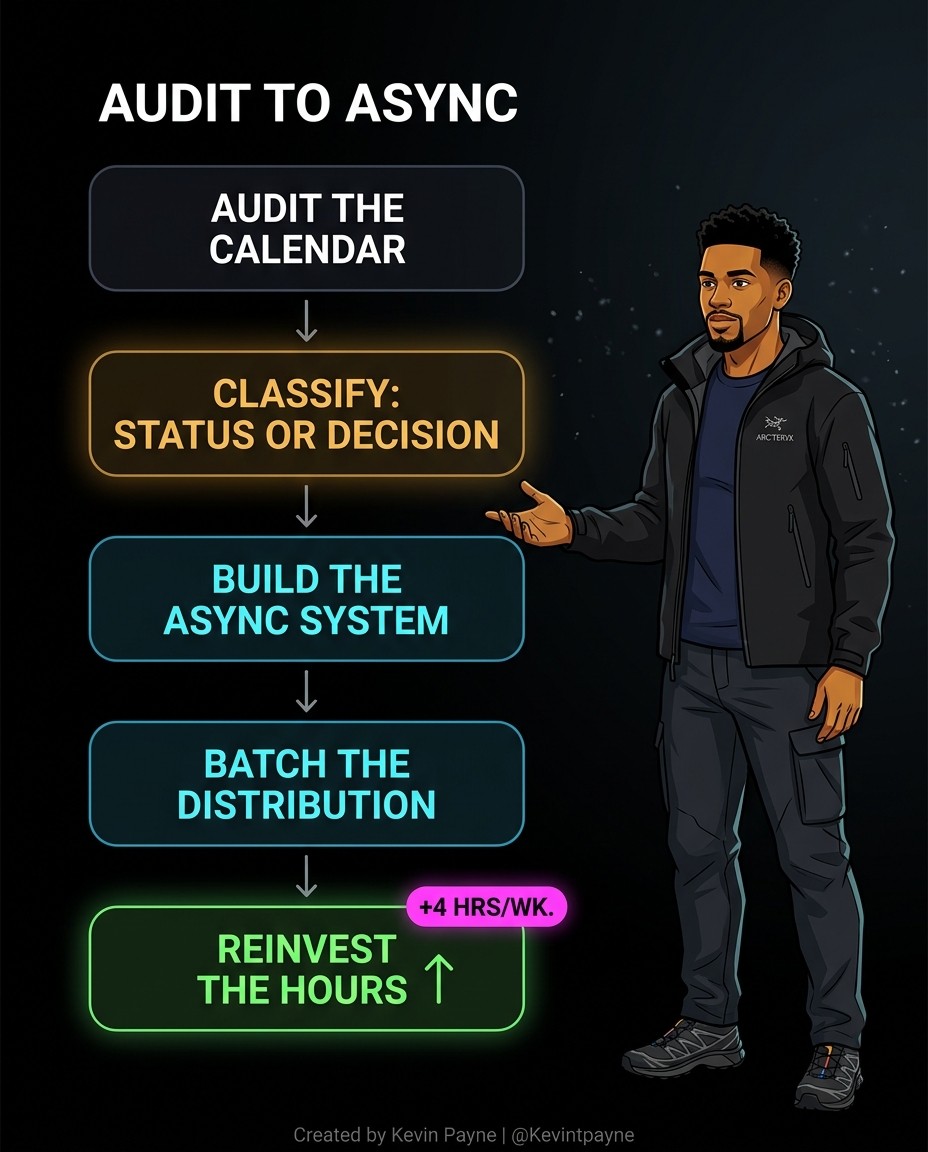
A simple way to free the first hours: audit your calendar, sort each block into status or decision, move status work to async, and reinvest what you save.
How do you budget time and energy across streams?
Give each stream a fixed weekly block and a job: earn, build or maintain. Otherwise client work fills every hour.
An illustrative 40-hour week for an operator running three streams, with round hypothetical numbers:
Block | Hours | Job |
|---|---|---|
Consulting delivery | 20 | Earn |
Consulting sales and follow-up | 4 | Earn |
Content writing and publishing | 8 | Build |
Community moderation and events | 4 | Maintain |
Admin, invoicing and taxes | 4 | Maintain |
Three rules keep the budget honest:
Protect the build block. Put content and course work where your best focus sits, and client calls around it.
Cap delivery. If delivery passes about half your week, raise prices or stop selling for a month.
Review monthly. Compare hours spent with revenue earned per stream. A stream that takes 20% of your time and returns 5% of revenue needs a fix or an exit date.
Automation helps most in the maintain blocks, such as invoicing reminders and community onboarding; the services page shows the kinds of workflows I set up for clients.
Protect the hours before you add a stream: capture the 20 percent of work that needs you, and schedule or hand off the rest.

What should you check in your contracts before you start?
If you start a stream while still employed, read your employment agreement and company policies before you take a dollar. This is general guidance, not legal advice; ask an employment lawyer about your situation.
What to look for:
Outside work or moonlighting policy. A SHRM article on moonlighting policies quotes an employment attorney saying "an employee is never permitted to use the employer's time or resources" for outside work. It lists working for a competitor and a "high risk of disclosure of confidential information" as conflict criteria employers consider.
Invention assignment and IP clauses. Some states limit how far these reach. California Labor Code section 2870 excludes inventions developed "entirely on his or her own time" without the employer's equipment, supplies, facilities or trade secrets, unless they relate to the employer's business or result from work done for the employer.
Non-compete and non-solicit terms. Check whether you can serve clients in your employer's market or approach its customers.
Disclosure requirements. Some policies require disclosure, though the same SHRM article notes California does not let employers require advance permission for outside work.
Confidentiality. Nothing from an employer, client or past client goes into content, courses or community posts without permission.
With clients, your consulting contract should say who owns the templates and frameworks you reuse, so a project does not lock up the method you teach.
What are the tax and admin basics?
In the US, independent income usually means self-employment tax and quarterly estimated payments. A tax professional covers your specifics.
From the IRS page on self-employment tax:
Rate. "The self-employment tax rate is 15.3%," made up of 12.4% for Social Security and 2.9% for Medicare.
Threshold. You file Schedule SE if your net earnings from self-employment were $400 or more.
Deduction. You can deduct the employer-equivalent portion of self-employment tax when figuring adjusted gross income.
From the IRS page on estimated taxes: individuals generally make estimated payments "if they expect to owe tax of $1,000 or more when their return is filed," using Form 1040-ES, across four payment periods.
An admin setup checklist:
Separate business bank account for all stream income
One invoicing tool and a standard contract template
A set percentage of every payment moved to a tax account
Quarterly estimated payment dates in your calendar
A monthly 30-minute review of income per stream
What does a 90-day plan look like?
Spend the first 30 days on one paid offer, the next 30 on delivery and proof, and the last 30 on your first compounding stream.
Days 1 to 30: launch one offer.
Write a one-page offer for your fastest stream, usually consulting or advisory.
Clear your contracts using the checklist above.
Set up the admin basics.
Have 10 conversations with people who already know your work.
Days 31 to 60: deliver and document.
Deliver the first project and write down every step.
Ask for a testimonial and permission to describe the work in general terms.
Publish one piece a week drawn from what you learned.
Days 61 to 90: add the compounding stream.
Pick content, a course module or a community based on the scoring pass.
Turn your documented delivery steps into the first asset.
Run the monthly review and set next quarter's hours.
If your next move is a deeper skill shift rather than a new stream, the guide on the GTM engineer to AI engineer career path maps it out. If you want a remote role as one anchor in the portfolio, see remote GTM engineer jobs at Series A and B companies.
What are the common mistakes?
The most common mistake is launching several streams at once. Most others come from skipping admin.
Starting with the slowest stream. A course with no audience waits a long time for its first sale.
Pricing by the hour forever. Hourly pricing caps the consulting line and leaves no time for the streams that compound.
Skipping the contract read. An IP clause found after launch is far harder to fix.
Ignoring estimated taxes. A year of untaxed income turns into one large bill and possible penalties.
No weekly blocks. Without them, delivery eats the build time every week.
Never cutting a stream. If a line has missed its targets for two quarters, close it and give the hours to what works.
FAQ
What is a portfolio career in simple terms?
A working life built from several income streams, such as consulting, content and courses, that you choose and schedule on purpose.
Who came up with the term portfolio career?
Management thinker Charles Handy is usually credited with it. Jeff Goins traces it to Handy's 1989 book The Age of Unreason.
How many income streams should a portfolio career have?
Start with one paid stream and add a second only when the first runs on a fixed weekly block.
Which stream should an operator start with?
Usually consulting or advisory, because buyers already exist and revenue can arrive in weeks. Content, courses and community take longer and work best once you have proof.
Do I need to tell my employer about outside work?
Check your employment agreement and policies first, and ask an employment lawyer about your specific case.
What taxes apply to portfolio career income in the US?
Usually income tax plus self-employment tax, which the IRS sets at 15.3%. If you expect to owe $1,000 or more, the IRS generally expects quarterly estimated payments.
Talk through your portfolio career
If you are planning your first independent stream, pricing a consulting offer or deciding which line to add next, book a short intro call and we can map out your next 90 days. If you are hiring and want to see which manual work an operator should take on first, the free Leak Call costs it out for one team.
Running revenue at a Series A or B SaaS company and not ready to hire? Ask about the 90-day AI RevOps Sprint. I take two clients at a time.
About the author: Kevin Payne is an AI engineer and GTM operator who installs AI workflows for B2B teams. He has 10+ years in B2B SaaS demand generation and RevOps across Techstars, a16z and YC portfolio companies, and his writing has appeared in HubSpot, GetResponse, Outbrain and more.